

From niche to norm
Singular Solutions for circular electronics built on Cradle to Cradle already exist. Now, the C2C Electronics Initiative brings together what belongs together: companies, civil society and academia form a living network of knowledge and practice with the C2CEI. This network advances new and existing C2C approaches toward market readiness and scalability, and puts circular electronic products and business models into practice.
Together, we're shaping the future of the electronics industry.
Initiators



Why circularity is a strategic imperative
On average, a metric ton of mobile-phone scrap contains 250 grams of gold, 2.5 kilograms of silver and 92 kilograms of copper, plus palladium, cobalt and other critical raw materials. The problem: most of it ends up as waste while only a fraction is recycled.
The reasons: products are designed for single use, not for circularity. And business models lack a path for materials to be brought back into the cycle.
The consequences: growing dependence on fragile supply chains, rising raw-material costs, missed markets and jobs, and needless, costly environmental damage.
To avoid this and at the same time cut costs, open up new markets, create jobs, protect the climate and resources the industry has to consistently keep resources in the cycle.
Cradle to Cradle as a solution
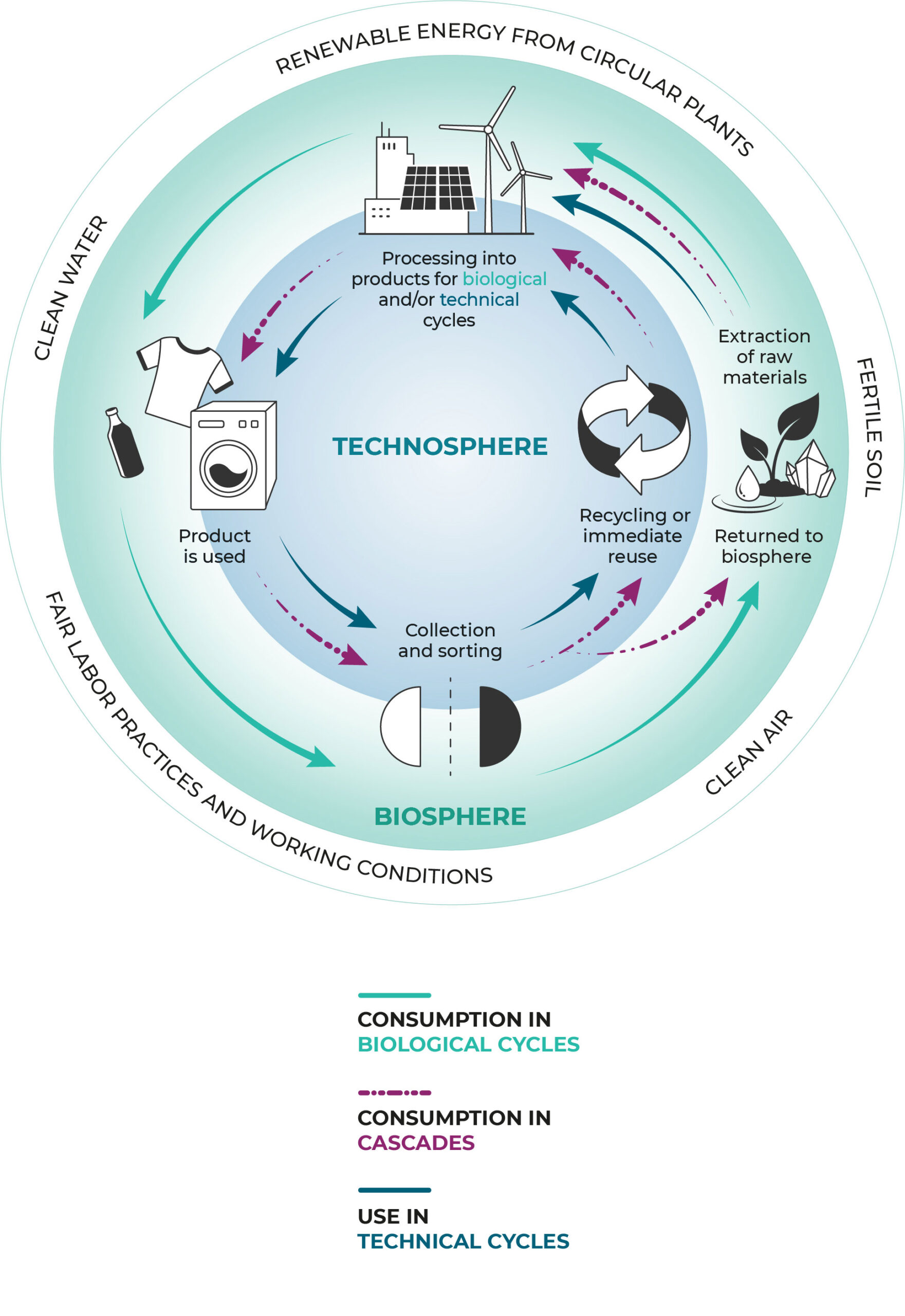
The product design: Cradle to Cradle design uses materials chosen to suit a product's intended use – healthy and cleanly separable. Every component can be reused. Raw materials return to production at consistent quality: no downcycling, no harmful substances in the environment. There's no electronic waste to begin with.
The business model: Circular material cycles cut costs, risks and dependence on fragile supply chains. Take-back systems easily and reliably return devices and their materials to the cycle after use.
The impact: Less dependence on raw-material imports, greater profitability, and fewer environmental and health risks. An industry that creates real value – socially, economically and environmentally.
One initiative. Six levers.
The Cradle to Cradle Electronics Initiative tackles six key challenges for the electronics industry:
1. From linear to circular
We show how the transformation works across design, material choices, and business models – financing and the business case included.
2. Strengthening resilience
Stable, circular material cycles cut costs and reduce risks and dependencies within the supply chain. Making not just the electronics industry but Europe's whole economy more resilient.
3. Helping shape regulation
The initiative actively helps shape future regulation.
4. Pooling knowledge
Scattered know-how, data and hands-on experience from business, civil society and academia, brought together in one place.
5. Harnessing digitalization
Data brings transparency to the entire supply chain, a key to true circularity.
6. Scaling solutions
Individual projects become transferable results for the whole industry to use.
VOICES OF THE INITIATORS
Hands-on projects, clear goals
The initiative works on two levels: development of concrete products and business models as well as research and knowledge-sharing on key questions. The goal: practical insights the industry can use straight away.
To get there, the C2C Electronics Initiative pursues three overarching goals:
Embedding in practice
Cradle to Cradle principles need to become part of everyday design, procurement and development. Not as theory, but in action. To make that happen, we are building a "Community for Change": a network that drives the transformation through shared best practices and common standards.
Policy recommendations
Our work produces recommendations for policymakers and legislators to remove regulatory barriers and systematically support circular innovation.
Raising awareness
We show what's possible today, not as a vision, but as a reality. And that encourages others to do the same.
In the long run, the electronics industry becomes a pioneer sector – showing that circularity is a business case and setting an example for other industries.